
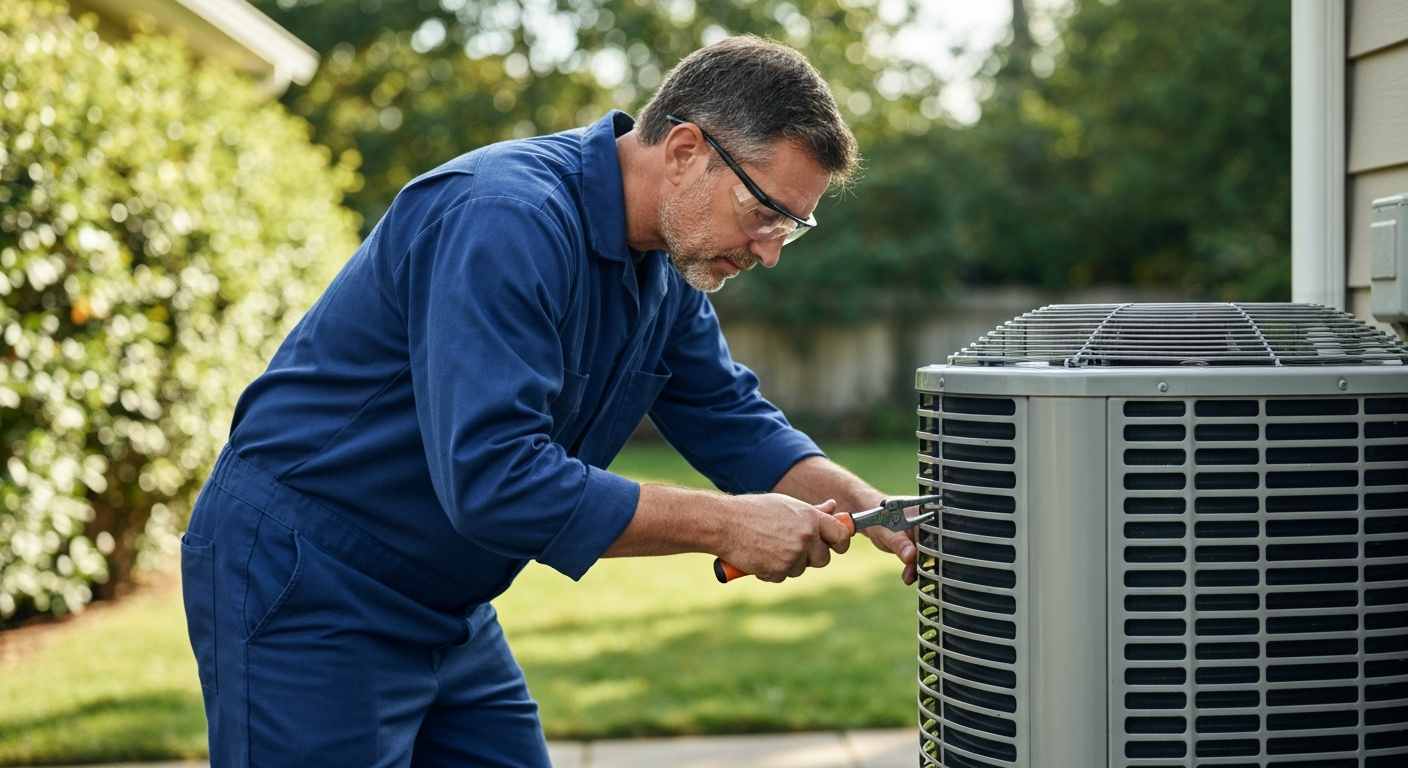
HVAC/R Technician
Keep the world comfortable and vital systems running with a career in heating, cooling, and refrigeration.
Quick Facts
| Median Annual Wage | $59,810 |
| Median Hourly Wage | $32.75 |
| Projected Growth | 8% (2024–2034) |
| Annual Openings | ~40,100/year |
| Typical Entry Path | 3-5 year Apprenticeship or Trade School |
| Physical Demands | Heavy lifting, extreme temperatures, working in tight or high spaces |
*Sources: BLS Occupational Outlook Handbook (May 2024 data, accessed July 5, 2026) and BLS OEWS (May 2025 release, published May 15, 2026).
Find Trade Info in Your State →Day in the Life
An HVAC/R technician's day shifts constantly between hands-on mechanical work and technical troubleshooting. On a commercial job, you might start the morning on a hot rooftop, diagnosing a failing compressor on a massive chiller unit. You will be checking refrigerant pressures, testing electrical relays, and reading complex wiring diagrams to find the fault. Once the issue is identified, you will repair or replace the components, ensuring the building's climate control is restored before the midday heat peaks.
If you are working in residential service, you might visit several homes in a single day. You could be crawling under a house to inspect ductwork, installing a high-efficiency heat pump, or explaining a thermostat issue to a homeowner. The work requires a deep understanding of thermodynamics, electrical systems, and airflow, all while adapting to environments that range from freezing walk-in coolers to sweltering attics.
Data centers require intensive, specialized cooling systems to prevent server failure. HVAC/R technicians who develop expertise in data center climate control are seeing strong, growing demand as AI and cloud computing infrastructure expands. This specialization offers a distinct career path for technicians looking to focus on emerging technologies and mission-critical commercial environments.
The Career Ladder
Check the state tool for stage-by-stage local pay instead of guessing figures.
How to Get Started
- Check State Requirements: Research your local licensing board to understand the specific hours and exams required to work legally in your area.
- Get Your EPA Certification: Federal law requires EPA Section 608 certification to handle refrigerants. You cannot work as a full technician without this.
- Choose Your Path: Decide whether to pursue a union apprenticeship, a non-union apprenticeship, or a foundational program at a trade school.
- Apply and Enter Training: Start applying to programs or contractors. Visit Apprenticeship.gov or our Trade School Directory to find structured training.
- Work as a Helper: If waiting for an apprenticeship spot, look for helper roles to gain immediate experience carrying gear and observing technicians.
- Complete Apprenticeship and License: Finish your required on-the-job hours and classroom instruction, then take your state or local exams to earn your license.
Union vs. Non-Union
| Union (e.g., United Association) | Non-Union (Merit Shop) |
|---|---|
| Highly structured 5-year apprenticeship with standardized curriculum and scheduled raises. | Training structure varies by employer; often involves trade school combined with on-the-job learning. |
| Wages are collectively bargained and set by local union contracts. | Wages are negotiated individually and depend heavily on performance and the employer. |
| Benefits typically include robust pension, health insurance, and annuity funds. | Benefits vary widely; may include 401(k) matching and health insurance, or may be limited. |
| Job placement is handled through the union hall. | You apply for jobs directly with contractors and manage your own career moves. |
| Mobility can be restricted by local jurisdiction rules, though traveling is possible. | Free to move and work anywhere, though you must secure your own employment. |
Apprenticeship
Wages
Benefits
Job Placement
Mobility
Total compensation includes pension, health, annuity, and union dues—not just the hourly wage. Always compare the full package directly rather than assuming one is better. Note that a large share of residential HVAC work is non-union.
Tools & Safety Gear
Starter Toolkit
- Multimeter (essential for electrical troubleshooting)
- Screwdriver set (multi-bit and insulated)
- Wire strippers and crimpers
- Adjustable wrenches and pliers
- Tape measure
- Nut drivers
Safety Gear
- Sturdy work boots (composite or steel toe)
- Safety glasses
- Insulated work gloves
- Knee pads
- Ear protection (for loud mechanical rooms)
Note: Gear links may be affiliate links, disclosure applies. We only recommend what we'd tell a real apprentice to buy. View our Tools & Gear hub, filtered for HVAC/R.
Training & Schools
HVAC/R technicians often start by attending a trade or technical school for 6 to 12 months to learn the fundamentals of electricity, thermodynamics, and refrigerant handling before finding an employer to sponsor their remaining apprenticeship hours. Alternatively, union apprenticeships provide direct earn-while-you-learn training over 5 years. Check out our Trade School Directory, filtered for HVAC/R and our Apprenticeships & Training hub to weigh your options.
Women in the Trades
The HVAC/R industry is actively working to recruit more women to combat severe labor shortages, offering excellent earning potential and a highly technical, brain-engaged career path. Many local unions and trade organizations offer dedicated mentorship and support networks to help women succeed in the field. Learn more at our Women in the Trades hub.
Pros & Cons
Pros
- Year-round demand regardless of the broader economy
- Highly technical work that challenges your brain
- Strong potential for overtime pay and emergency call bonuses
- Clear path to starting your own contracting business
Cons
- Working in extreme temperatures (hot attics, freezing roofs)
- On-call shifts require working nights, weekends, or holidays
- Physically demanding lifting and maneuvering in tight spaces
- Risk of exposure to refrigerants and high voltage
Related Trades
If HVAC/R interests you, also consider: Plumber, Pipefitter/Steamfitter, Electrician, Solar Installer, or Industrial Maintenance Technician.
Safety Disclaimer
GetInTheTrades.com is an informational career resource. HVAC/R work can be dangerous and may require licensing, permits, code compliance, and supervised training. Do not attempt professional HVAC/R work without proper instruction, safety equipment, and licensed supervision where required.
Sources
- Bureau of Labor Statistics, U.S. Department of Labor, Occupational Outlook Handbook, Heating, Air Conditioning, and Refrigeration Mechanics and Installers (May 2024 data, accessed July 5, 2026).
- Bureau of Labor Statistics, U.S. Department of Labor, Occupational Employment and Wage Statistics (OEWS), May 2025 release, published May 15, 2026.