
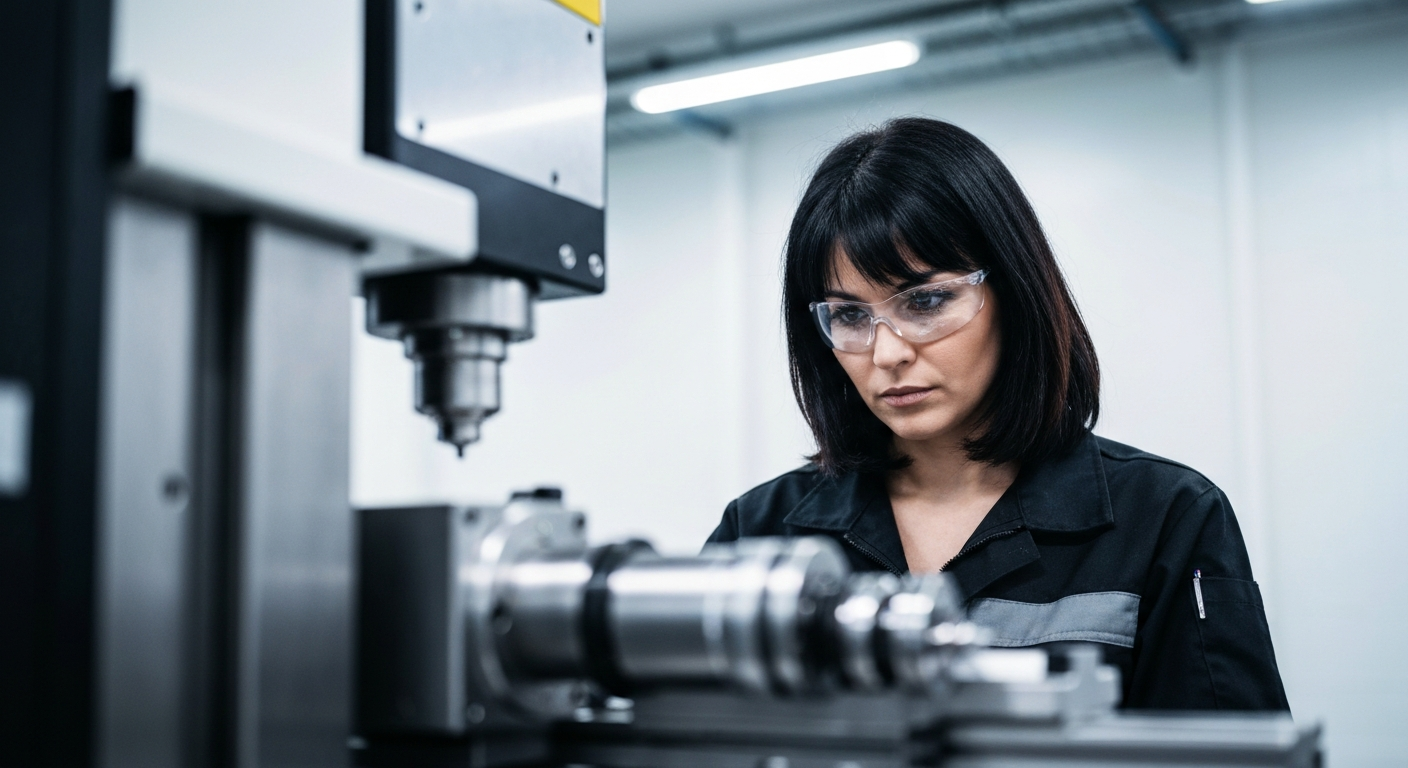
CNC Machinist
Program and operate precision computer-controlled machines to create complex metal and plastic parts.
Quick Facts
| Metric | Details |
|---|---|
| Median Annual Wage | $56,150* |
| Median Hourly Wage | See state tool |
| Projected Growth (2024–2034) | -2% (slight decline)* |
| Projected Annual Openings | ~34,200/year* |
| Typical Entry Path | 1-2 year technical certificate/degree + on-the-job training |
| Physical Demands | Moderate (standing for long periods, lifting materials) |
*Source: BLS Occupational Outlook Handbook ("Machinists and Tool and Die Makers", accessed July 2026). Note: The projected growth reflects a slight overall decline due to automation and efficiency gains; however, substantial openings remain (~34,200/year) due to the need to replace retiring workers.
Find Trade Info in Your State →Day in the Life
A CNC (Computer Numerical Control) Machinist bridges the gap between digital design and physical manufacturing. A typical day starts with reviewing blueprints and CAD/CAM (Computer-Aided Design/Manufacturing) files. You will program the CNC machines, select the appropriate cutting tools, and set up the raw materials—often metal or high-grade plastics—to be milled, turned, or drilled with extreme precision.
Once the machine is running, the job shifts to monitoring the process, listening for tool wear, and adjusting speeds or feeds as necessary. Precision measurement and quality control are constant requirements; you will use micrometers, calipers, and other gauges to ensure parts meet tolerances that are often measured in ten-thousandths of an inch. It's a clean, highly technical indoor environment that requires deep focus and problem-solving skills.
The Career Ladder
Pre-apprentice / Helper / Machine Operator
Entry-level role focused on loading raw materials, running pre-programmed jobs, and keeping the work area clean while learning the basics.
Apprentice / Trainee
Typically involves completing a 1-2 year technical school program combined with structured on-the-job training to learn programming, setup, and blueprint reading.
Journeyman / CNC Machinist
A fully qualified machinist capable of independent setup and programming. (Note: Machining does not use a state-issued journeyman license system; status is based on experience and industry certifications like NIMS).
Master
There is no formal state master tier in machining. Advancement relies on mastering multi-axis machines, CAD/CAM programming, and complex tooling.
Foreman / Lead Programmer
Manages the shop floor, oversees production schedules, and often serves as the primary programmer for complex new parts.
Project Manager / Shop Owner
Oversees entire manufacturing operations, client relations, and quality assurance, or runs an independent machine shop.
How to Get Started
Research Local Programs
Look into community college or technical school programs offering certificates or associate degrees in CNC machining or precision manufacturing.
Apply for Training
Enroll in a program to learn the fundamentals of blueprint reading, metrology (measurement), and basic machine operation.
Find an Entry-Level Job
Many students start working as machine operators or shop helpers while completing their schooling to gain hands-on experience.
Earn NIMS Certifications
Work towards National Institute for Metalworking Skills (NIMS) credentials, which validate your skills to employers.
Advance Through Experience
Move from operator to setup machinist, and eventually to programmer as you master G-code, CAM software, and complex multi-axis machining.
Check Apprenticeship.gov for formal registered apprenticeships, or visit our Trade School Directory to explore training programs.
Union vs. Non-Union
While unions like the IAM represent machinists in large-scale aerospace, defense, and automotive manufacturing, a significant portion of CNC machinists work in smaller, independent, non-union machine shops (often called job shops).
Apprenticeship
Union:
Structured, formal programs within large facilities.
Non-Union:
Often informal; relies on technical school + employer training.
Wages
Union:
Negotiated collective bargaining agreements with set scales.
Non-Union:
Negotiated individually based on skill, speed, and shop profitability.
Benefits
Union:
Typically comprehensive (pension, health, training funds).
Non-Union:
Varies widely by employer size; often 401(k) and standard health.
Job Placement
Union:
Often hired directly by large manufacturers.
Non-Union:
Apply directly to independent shops.
Mobility
Union:
Clear seniority tracks within a large organization.
Non-Union:
High mobility; skilled programmers are in demand across shops.
| Feature | Union (e.g., IAM) | Non-Union (Job Shops) |
|---|---|---|
| Apprenticeship | Structured, formal programs within large facilities. | Often informal; relies on technical school + employer training. |
| Wages | Negotiated collective bargaining agreements with set scales. | Negotiated individually based on skill, speed, and shop profitability. |
| Benefits | Typically comprehensive (pension, health, training funds). | Varies widely by employer size; often 401(k) and standard health. |
| Job Placement | Often hired directly by large manufacturers. | Apply directly to independent shops. |
| Mobility | Clear seniority tracks within a large organization. | High mobility; skilled programmers are in demand across shops. |
Remember: total compensation includes pension, health coverage, and dues where applicable, not just the hourly wage. Compare the full package.
Tools & Safety Gear
Starter Toolkit
- 0-1" Micrometer
- 6" Digital or Dial Calipers
- 6" Steel Rule
- Edge Finder
- Basic Allen Wrench Set
- Small Tool Box or Kennedy Box
Required Safety Gear
- ANSI-rated Safety Glasses (with side shields)
- Steel-Toe or Composite-Toe Work Boots
- Hearing Protection (earplugs or muffs)
- Close-fitting clothing (no loose sleeves near moving spindles)
Gear links may be affiliate links, disclosure applies, we only recommend what we'd tell a real apprentice to buy. See our Tools & Gear hub.
Pros & Cons
Pros
- Clean, climate-controlled indoor working environment.
- Highly technical work that engages the mind and problem-solving skills.
- Less physically strenuous than construction trades.
- Strong demand to replace retiring workers, despite overall industry trends.
- Skills easily transfer across industries (aerospace, medical devices, automotive).
Cons
- Overall employment in the field is projected to decline slightly due to automation.
- Requires long periods of standing on hard concrete floors.
- Mistakes can be extremely costly (crashing a machine or scrapping expensive material).
- Can involve repetitive tasks during long production runs.
- Constant pressure to maintain extremely tight tolerances.
Training & Schools
Unlike many construction trades where you start on a jobsite immediately, CNC machining frequently begins with a formal trade or technical school program. A 1-2 year certificate or associate degree provides the essential foundation in blueprint reading, math, and programming that employers look for before letting you operate expensive machinery. Registered apprenticeships do exist, but trade-school-first is a very common and effective entry path.
Explore our Trade School Directory and Apprenticeships & Training hub for more guidance.
Women in the Trades
While precision machining is currently male-dominated, the clean, highly technical nature of CNC work makes it an excellent field for women entering the trades. Success relies entirely on attention to detail, programming logic, and precision rather than brute physical strength. Many manufacturing organizations and technical schools are actively recruiting women to help fill the gap left by retiring workers.
Learn more about support networks, gear, and opportunities at our Women in the Trades hub.
Related Trades
Interested in similar work? Check out: Millwright, Industrial Maintenance Technician, Welder, Diesel Mechanic, or Tool and Die Maker.
Safety Disclaimer
GetInTheTrades.com is an informational career resource. CNC machining work can be dangerous and may require licensing, permits, code compliance, and supervised training. Do not attempt professional machining work without proper instruction, safety equipment, and licensed supervision where required.
Sources
- Bureau of Labor Statistics, U.S. Department of Labor, Occupational Outlook Handbook, Machinists and Tool and Die Makers. May 2024 data, accessed July 5, 2026.
Ready to take the next step?
Find out what CNC Machinists make in your area or explore training programs.
Start Your Path →