Heavy Equipment Operator
Move the earth and build the foundation of major infrastructure and construction projects.
Quick Facts
| Metric | Details |
|---|---|
| Median Annual Wage | $58,320* |
| Median Hourly Wage | $31.87* |
| Projected Growth (2024–2034) | 4%* |
| Projected Annual Openings | ~46,200/year* |
| Typical Entry Path | 3-4 year apprenticeship or short certificate program |
| Physical Demands | Moderate to High (sitting for long periods, vibration, outdoor elements) |
*Source: BLS Occupational Outlook Handbook and OEWS May 2025 release (accessed July 2026).
Find Trade Info in Your State →Day in the Life
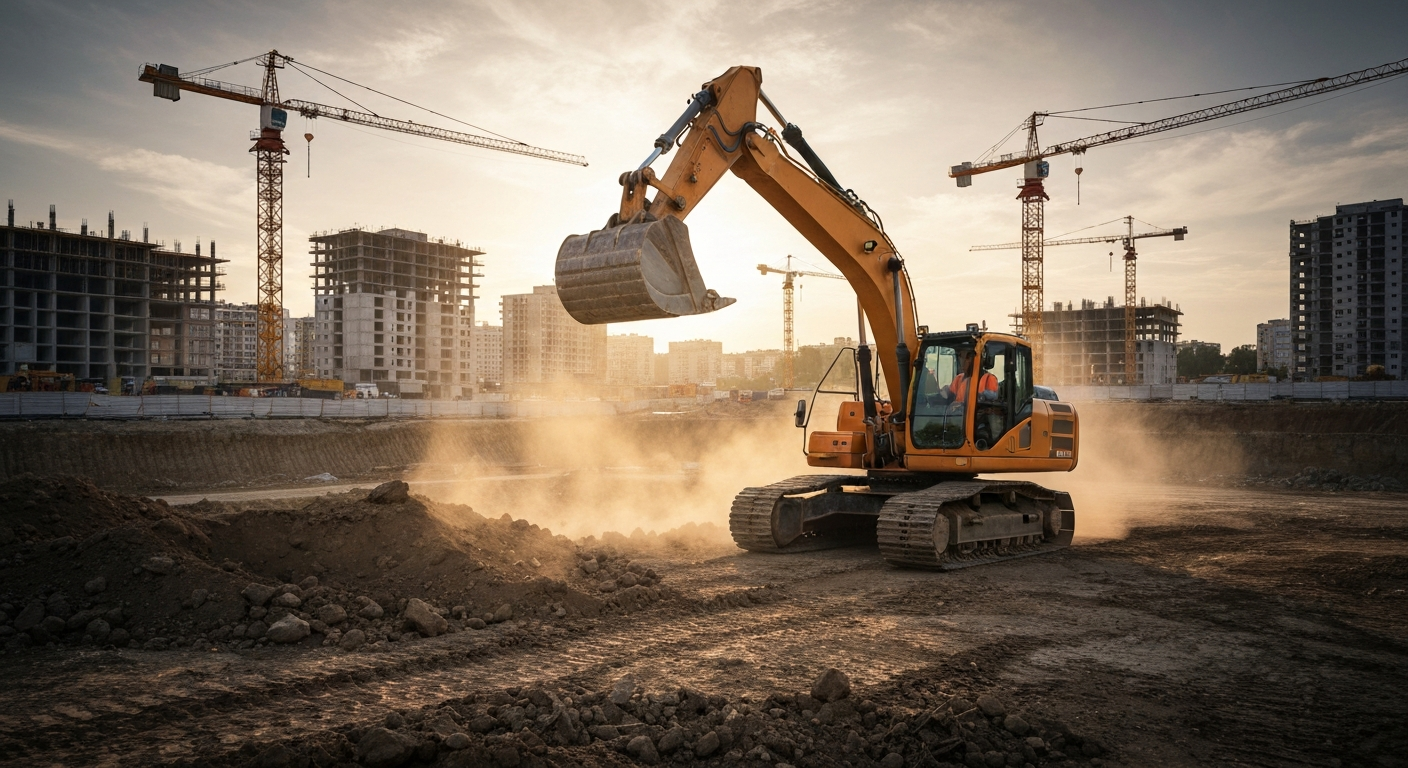
A heavy equipment operator's day is spent controlling the massive machines that make large-scale construction possible. Whether you are running an excavator to dig foundations, a bulldozer to grade land, a backhoe for utility trenching, or a crane to lift heavy steel beams, the work requires intense concentration. You will start by performing a pre-shift safety inspection on your machine, checking fluid levels, tracks, tires, and hydraulic systems before firing up the engine.
Once in the cab, you are constantly reading the terrain and communicating with ground crews via two-way radios or hand signals. The environment is active, loud, and outdoors in all weather conditions. Operating these machines requires a delicate touch and spatial awareness to move tons of earth or material with extreme precision, avoiding underground utilities and keeping ground workers safe.
The Career Ladder
Pre-apprentice / Helper / Oiler
Entry-level role focused on maintaining equipment (greasing, fueling, cleaning) and assisting operators on the ground while learning the basics.
Apprentice (3-4 years)
Combines classroom safety and operational theory with thousands of hours of supervised seat time on various pieces of equipment.
Journeyman / Operator
A fully qualified operator capable of running multiple types of machinery independently and safely. (Note: There is no formal state-issued journeyman license for this trade, but specific equipment like cranes requires strict NCCCO certification).
Master
There is no formal state master tier for equipment operators. Advancement means gaining certifications for highly specialized equipment (like tower cranes) and mastering complex grading/GPS systems.
Foreman / Lead
Coordinates the equipment fleet on a job site, manages other operators, and works directly with superintendents to sequence earthmoving tasks.
Project Manager / Superintendent / Own Business
Oversees entire site operations or launches an independent excavation/site-prep contracting company.
How to Get Started
Check Requirements
You need a high school diploma or GED, a valid driver's license, and you must pass a drug screen. A Commercial Driver's License (CDL) is highly recommended and often required to move equipment between sites.
Choose Your Path
Decide between applying for a union apprenticeship (typically 3-4 years, highly structured) or attending a heavy equipment trade school (weeks to months) to get initial seat time before applying to non-union contractors.
Apply for Training
Find local union halls via Apprenticeship.gov or search the Trade School Directory for accredited equipment operator programs.
Start as a Helper or Apprentice
Your first year will involve ground work, greasing machines, and learning safety protocols before getting significant seat time on complex equipment.
Earn Certifications
As you gain experience, acquire specific certifications (like NCCCO for cranes or OSHA safety credentials) to increase your employability and pay rate.
Union vs. Non-Union
Apprenticeship
Union:
Highly structured 3-4 year apprenticeship with standardized curriculum and extensive training facilities.
Non-Union:
Training is often employer-specific or requires paying out-of-pocket for a trade school program first.
Wages
Union:
Wages are strictly negotiated and standardized by the local union contract.
Non-Union:
Wages are negotiated individually based on your skill level, certifications, and the employer.
Benefits
Union:
Excellent benefits package (pension, family health insurance) funded by employer contributions.
Non-Union:
Benefits vary widely by employer (often 401k match and partial health coverage instead of pension).
Job Placement
Union:
Dispatched to contractors through the union hall based on the out-of-work list.
Non-Union:
You must apply directly to contractors and manage your own job search.
Mobility
Union:
Dominates large commercial, infrastructure, and heavy highway projects.
Non-Union:
Common in residential site prep, landscaping, and smaller commercial work.
| Factor | Union (IUOE) | Non-Union (Open Shop) |
|---|---|---|
| Apprenticeship | Highly structured 3-4 year apprenticeship with standardized curriculum and extensive training facilities. | Training is often employer-specific or requires paying out-of-pocket for a trade school program first. |
| Wages | Wages are strictly negotiated and standardized by the local union contract. | Wages are negotiated individually based on your skill level, certifications, and the employer. |
| Benefits | Excellent benefits package (pension, family health insurance) funded by employer contributions. | Benefits vary widely by employer (often 401k match and partial health coverage instead of pension). |
| Job Placement | Dispatched to contractors through the union hall based on the out-of-work list. | You must apply directly to contractors and manage your own job search. |
| Mobility | Dominates large commercial, infrastructure, and heavy highway projects. | Common in residential site prep, landscaping, and smaller commercial work. |
When comparing offers, remember that total compensation includes pension, health coverage, annuity, and dues—not just the hourly wage on your check. Compare the full package directly.
Tools & Safety Gear
Starter Kit (Pre-apprentice/Helper)
- Adjustable wrenches and basic socket set (for minor maintenance/greasing)
- Grease gun
- Utility knife
- Heavy-duty flashlight or headlamp
Required Safety Gear
- Steel-toe or composite-toe work boots (with good ankle support and mud traction)
- High-visibility clothing or safety vest
- Hard hat
- Safety glasses and heavy-duty work gloves
- Hearing protection (earplugs or earmuffs)
Gear links may be affiliate links, disclosure applies, we only recommend what we'd tell a real apprentice to buy. See our Tools & Gear hub, filtered for Heavy Equipment.
Pros & Cons
Pros
- Incredible sense of scale and accomplishment building major infrastructure.
- Less manual lifting and physical labor compared to trades like masonry or ironworking (you let the machine do the heavy lifting).
- Strong earning potential, especially for specialized equipment like cranes.
- Work is almost entirely outdoors with constantly changing scenery.
Cons
- Work is highly weather-dependent; heavy rain or freezing conditions can halt earthmoving, leading to seasonal layoffs in some climates.
- Sitting in a cab for 10-12 hours a day can cause back and neck strain over time due to vibration and posture.
- Extremely high responsibility for site safety; a mistake with heavy machinery can be catastrophic.
- Loud, dusty, and muddy working environment.
Training & Schools
A union apprenticeship is the most comprehensive path, offering thousands of hours of paid seat time on diverse equipment without tuition debt. However, because union spots are highly competitive, many operators start by attending a heavy equipment trade school or community college program to earn initial certificates and basic seat time before securing non-union entry-level jobs.
Check out the Trade School Directory, filtered for Heavy Equipment, and read our general Apprenticeships & Training hub to learn more.
Women in the Trades
Heavy equipment operation is an increasingly popular trade for women because the work relies on precision, finesse, and spatial awareness rather than raw physical lifting strength. Many local unions and contractors are actively recruiting women operators to meet infrastructure demands.
To learn more about jobsite culture, finding supportive programs, and connecting with other tradeswomen, visit our Women in the Trades hub.
Related Trades
If heavy equipment operation interests you, you might also want to explore: Carpenter, Ironworker/Structural Steel Worker, Diesel Mechanic, Millwright, or Mason.
Safety Disclaimer
GetInTheTrades.com is an informational career resource. Heavy equipment operation can be dangerous and may require licensing, permits, code compliance, and supervised training. Do not attempt professional heavy equipment operation without proper instruction, safety equipment, and licensed supervision where required.
Sources
- Bureau of Labor Statistics, U.S. Department of Labor, Occupational Outlook Handbook, Construction Equipment Operators, May 2024 data (accessed July 5, 2026).
- Bureau of Labor Statistics, U.S. Department of Labor, Occupational Employment and Wage Statistics (OEWS), May 2025 release (published May 15, 2026).
Ready to Move the Earth?
Stop guessing and start building your career. Find out exactly what it takes to get started in your state.
Start Your Path →